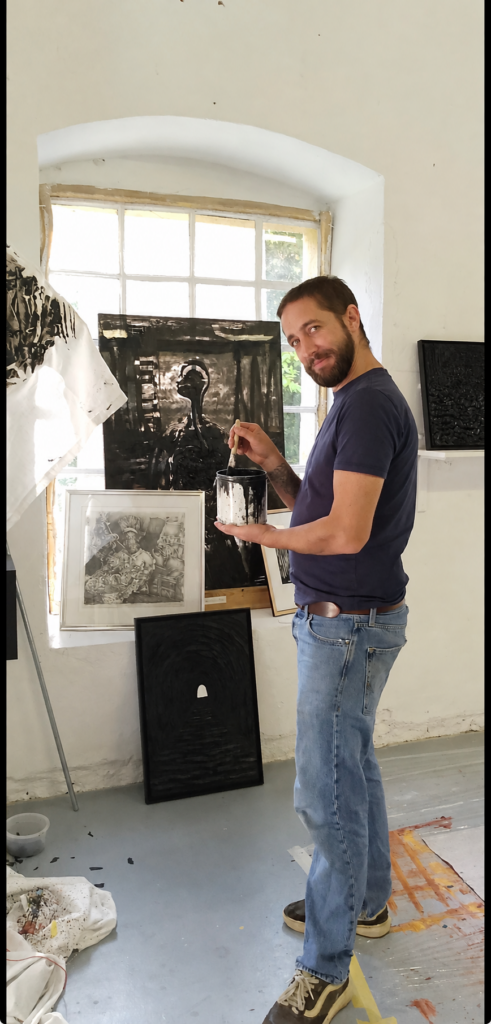
Born in Brussels in 1986, Jona Derenne grew up in Bolivia, where he lived from the age of two until he was seventeen, before returning to Belgium. His experience of living between two continents and two cultures has profoundly shaped his reflections on identity and the sense of belonging.
After studying fine arts in Brussels, he pursued a career in the culinary arts, working as a chef for twelve years. Since settling in Luxembourg three years ago, he has rediscovered his passion for painting and developed an intuitive and experimental artistic practice.
His work brings together the worlds of cooking and painting, two disciplines in which gesture, materiality, and experimentation play an essential role. Through this dialogue, he explores the connections and boundaries between these two creative fields.
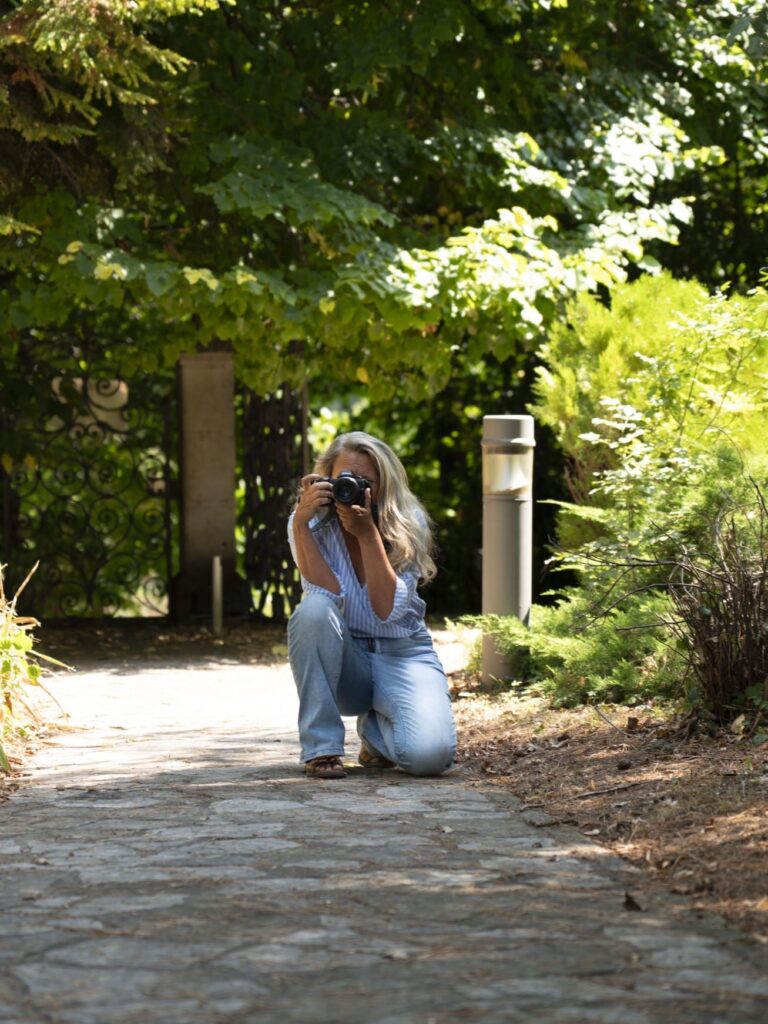
There is no such thing as chance; there are only rendez-vous. This sentence by Paul Éluard perfectly sums up Yseult D.’s career.
Nothing seemed to predestine her for a career in photography. The daughter of the Depelseneer couple, pioneers of the baby swimming method, Yseult worked for many years alongside her parents in this deeply human and fascinating field.
In 2011, driven by her long-standing passion for photography and cinema, she began attending evening classes in digital photography with Pierre Scheys, where she acquired the technical foundations of the medium. At the same time, she worked in Paris with her painter friend Marc Aghemio, who encouraged her to develop and refine her artistic eye.
A year later, diploma in hand, Yseult travelled to Israel.
What began as a celebratory trip would become a decisive turning point in her professional life. Back in Belgium, a chance encounter at her hairdresser’s led to an opportunity to share the photographs she had taken during her stay. The Jewish Community Centre in Brussels gave her carte blanche to create her first exhibition, Once Upon a Time in Jerusalem, presented under the name Yseult D.
The enthusiastic response from the public encouraged her to devote herself fully to artistic photography.
Today, Yseult D. is a Belgian visual artist and photographer based in Luxembourg. Her practice explores light, simplicity and the poetry of everyday life. Working primarily with photography, but also with video and textile installations, she pays particular attention to the materiality of the image and to the relationship between the image, space and the viewer.
Her approach is slow and contemplative. As a nomadic photographer, she observes before photographing, often taking only a single image of a given moment. Her photographs seek to capture what is quiet, fleeting and sometimes almost imperceptible.
Her work has been presented in Belgium and internationally, including in Venice and Milan, and has been selected for exhibitions and artistic projects such as the Arte Laguna Prize and Milan Design Week.
Livia (1997, Sweden) is a Swedish–Italian artist who grew up in Luxembourg. She holds a Bachelor’s degree in Fine Arts from the Royal Academy of Art in The Hague (KABK). Following her studies, she entered the professional art world, collaborating with Barbara Seiler Gallery in Zurich and participating in international art fairs and exhibitions.
In 2023, she joined the Master’s programme in Arts and Culture at Maastricht University, driven by a desire to deepen the theoretical dimension of her practice and her understanding of the cultural and educational landscape.
Her work unfolds at the intersection of artistic creation and critical reflection, exploring how art is shaped, mediated, and experienced within contemporary society. Engaging in dialogue with other artists, theorists, children, and broader audiences, she seeks to position her practice within a shared and evolving cultural space.
Childhood lies at the core of her work. Drawing on nostalgic references (toys, patterns, and familiar visual codes) she revisits themes that continue to resonate into adulthood. Through this lens, she addresses subjects often considered difficult or uncomfortable, including greed, immorality, fear, and injustice.
Play becomes a method: a way to process, reframe, and question reality. Yet this focus is not innocent. It reflects a deeper fascination with dualities, innocence and maturity, mischief and intention, wonder and cynicism.
Her work draws from contemporary events, popular culture, historical narratives, and everyday conversations, aiming to remain both disarmingly playful and quietly unsettling.
The music of Tacheles is a blend of world music and jazz, shaped by influences from Klezmer and Balkan traditions. Benedikt Schweigstill (accordion) and Tanja Silcher (double bass) perform their own compositions, presented with finesse and passion. Their concerts are characterized by a strong sense of playfulness, spontaneity, and flexibility. The two musicians deliver an energetic performance of a very high musical standard.
Benedikt Schweigstill, as a jazz pianist and composer, is considered one of the pillars of the Trier jazz scene. He has also been involved in numerous projects as an accordionist. Tanja Silcher is a professional musician who has established herself over the years as a double bassist in the Greater Region. In addition to her work as a bassist, she composes her own songs with German lyrics, which she performs as a songwriter.
Tanja Silcher and Benedikt Schweigstill have been making music together since 2008. Their long-standing musical journey has created a deep connection between them, allowing their playing to merge into a highly harmonious unity.
Stella Radicati (Italy, 1985) is a visual artist, art historian, and university lecturer in Art History, working between Italy, Luxembourg, and Switzerland. Her background spans visual arts, art history, and literary studies, shaping a practice in which artistic research, writing, and critical reflection are deeply intertwined.
Her work unfolds through drawing, painting, and installation, exploring themes of memory, time, and identity. Radicati’s visual language is restrained and essential, leaving room for silence, absence, and the emotional involvement of the viewer. Her images exist in a suspended space between the symbolic and the personal, where narration and subtraction, presence and fragility, remain in constant dialogue.
Alongside her artistic practice, she is actively engaged in teaching, research, and cultural dissemination, collaborating with universities and cultural institutions at an international level. She is currently pursuing a PhD in Literature at the University of Luxembourg, in joint supervision with the University of Rome Tor Vergata, focusing on the relationship between art and poetry.
Fabio Bottani is an Italian-Luxembourgish filmmaker. His debut medium-length feature, L’Arrivée de la Jeunesse, explores a century of Italian immigration in Luxembourg. Born in Milan and raised in Luxembourg from the age of five, he grew up surrounded by the traces of the country’s industrial past, shaped by thousands of workers who arrived from southern Europe in the early 1900s.
Blending fiction and archival material, the film follows a single Italian family from 1908 to today, using their journey as a thread to explore identity, migration, and belonging. Produced by PassaParola Group and co-financed by Esch 2022, the project was filmed across Luxembourg, with significant archival contributions from the CNA in Dudelange.
For Bottani, this story is both personal and universal. The migration that transformed Luxembourg is often forgotten, despite its profound cultural impact. The film pays tribute to those who left everything behind to offer a better future to the generations that followed. It also reflects on the recurring challenges faced by newcomers, from discrimination to today’s language barrier in an increasingly multilingual country.
Through its hybrid form and century-spanning narrative, L’Arrivée de la Jeunesse offers a unique cinematic perspective on how immigration has shaped Luxembourg and continues to define its identity.
Maya Likembe is the name of the musical project and band created by Luxembourgish singer-songwriter and composer Mary-Ann Meiers (born in Luxembourg, 1976).
The band’s name is a fusion of names referring to an Indian goddess, an ancient American civilisation and an African musical instrument. Its musical language and vocals are rooted in jazz but incorporate influences from Latin, world and soul music: “a blend of jazz with Latin, African, and soul influences, characterised by its unique and melodic nature”.
The themes and lyrics of the songs invite the listener on a magical journey, depicting surreal people, places and situations yet searching for a deeper sense, hope and love behind the apparently iconoclastic sceneries.
The band has featured a diverse range of musicians from various cultural backgrounds. Their releases included the single Ardent Traveller and the EP Spirituality Is the Beginning.
The next will be the digital and vinyl release of the single Wake Sleeping Beauty in October. Maya Likembe performs regularly in different venues in Luxembourg.
Current members of the band are Willian Fernandes (Brazil), Tanja Silcher (Germany), Amit Dhuri (India) and Frank Hemmerle (France).
Fulvia Monguzzi (Italy, 1985), known as Miss Goffetown, is an Italian artist based in Milan and trained at the Accademia di Belle Arti di Brera.
Her work, ranging from collage to acrylics, stands out for its ironic yet dramatic approach, exploring themes such as love, sensuality, and everyday life with a sensitive and poetic visual language. Serious yet playful, always curious about the world around her, Fulvia paints scenes in which we can all see ourselves. The absence of facial details emphasizes empathy and invites the viewer to fully immerse themselves in her subjects. An intimate and attentive gaze, capable of capturing every aspect of reality, reassembles in Miss Goffetown’s work new systems of relationships between people, places, and objects.
In Miss Goffetown’s research there is clearly a kind of provisional nature inherent in the practice of painting. Her incessant production of drawings throughout her days, which she herself describes as a daily “prayer,” carries the air of being thrown down somewhat casually, as an attempt, a series of acrylic paintings that seem unfinished or that cancel themselves out through a mark that resembles felt-tip pens more than brushes, as if the artist were distancing herself from painting in favor of something that constantly seems to be on the verge of incoherence or collapse.
Stéphane Guiran and Katarzyna Kot presented their work at the Domaine de Chaumont-sur-Loire (France) as part of the 2022 art season. This encounter gave rise to a desire to embark on a path of joint creation, embracing the Symbiocene and offering a different perspective on the challenges we face with climate change. Their duo G&K envisions tomorrow as a new chapter opening up, offering the possibility of writing new pages, imagining new stories, and other ways of being in the world.
Their meditative works are born from listening to the memory and fragility of the Great Living Beings of our planet (glaciers, forests, rivers, mountains…).
La nuit est une page blanche (The night is a white page) is their first creation. It brings together a series of works (sculptures, drawings, photographs, films, books, etc.) created or initiated on the Vatnajökull glacier in Iceland. Their offering of light in the heart of the night, at the time of the winter solstice, is a gesture of poetic resistance that explores new ways.
Jelena Bizel is a Serbian illustrator based in Luxemburg. Graduated in Graphic design at the Merz Academy in Stuttgart (Germany), she published her first book “Selbststigmatisierung” in 2014 where she expressed through illustrations and texts the psychological consequences of exclusion and integration of people in a community.
Her passion for psychology and sociology led Jelena to work on illustrations that reflect split personality within every human being. To express the multiplicity of one person, she developed a specific technic through the use of several layers of transparent paper in order to highlight different perspectives and emotions.
The exhibition displays an initial research on the process of awakening and transforming of women. The choice of paper is symbolic, invisible, untouchable, multi-layered, variable just like the character of a woman. Illustrations in several layers of transparent paper reflect the development and changes in the emotions of a woman, and the presence of flowers symbolizes beauty, change, awakening through which the woman passes through her life.